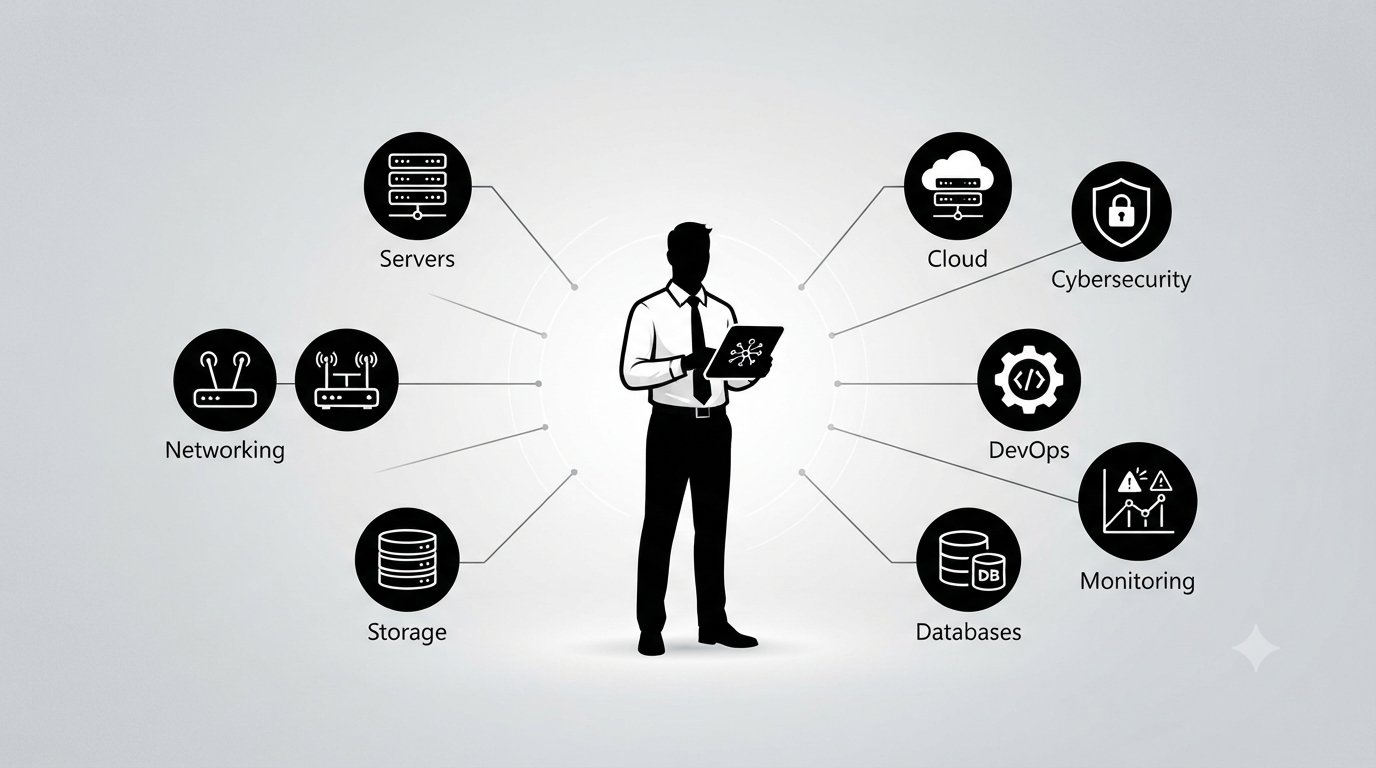
If you’ve worked in IT for more than twenty years, you’ve witnessed one of the biggest transformations our industry has ever experienced. The role of the traditional system administrator has gradually been divided into a collection of specialized positions: DevOps engineers, cloud architects, cybersecurity analysts, identity engineers, storage administrators, site reliability engineers, and countless others.
There’s nothing inherently wrong with this evolution. Technology has become more sophisticated, environments have grown exponentially, and specialization has helped organizations improve efficiency and reduce risk. But in the process, we’ve also lost something that was once considered essential: the broad, end-to-end knowledge that defined the seasoned system administrator.
When One Person Owned the Entire Environment
In the late 1990s and early 2000s, being a system administrator meant far more than maintaining Windows or Linux servers.
You built the infrastructure from the ground up. You configured routers and switches, deployed Active Directory, managed Exchange, maintained backups, secured the network perimeter, monitored performance, wrote automation scripts, responded to hardware failures, recovered systems after disasters, and supported the people who relied on those systems every day.
There wasn’t a dedicated cloud team, there wasn’t a DevOps engineer waiting to automate deployments, there wasn’t a security operations center reviewing alerts around the clock. The system administrator was expected to understand every layer of the environment because there was no one else to hand the problem to.
That responsibility created engineers who naturally developed a holistic understanding of technology rather than expertise in a single product or discipline.
The Rise of the Specialist
As enterprise IT matured, responsibilities became increasingly segmented. Infrastructure automation evolved into DevOps, security became an entire industry of its own, complete with analysts, penetration testers, governance teams, and professionals earning certifications like CISSP. Cloud computing introduced architects and platform engineers. Storage, networking, virtualization, identity management, compliance, and observability each became specialized career paths.
This shift wasn’t a mistake; it was inevitable.
Modern enterprise environments are simply too large and too complex for one individual to possess expert-level knowledge in every discipline Specialization allows organizations to build deeper expertise, standardize operations, and scale more effectively than ever before.
The Cost of Specialization
Where specialization sometimes falls short is in developing context.
I’ve worked with exceptionally talented DevOps engineers who could build sophisticated CI/CD pipelines but had never diagnosed a SAN failure or restored a broken Active Directory forest.
I’ve worked with cybersecurity professionals who understood attack frameworks, compliance standards, and threat intelligence in remarkable detail but had limited exposure to the operational realities of maintaining production infrastructure.
Neither scenario reflects a lack of skill; they’re simply products of modern career paths.
Today’s engineers are often encouraged to become experts within a defined scope rather than understanding how every component of the environment interacts with the others.
That distinction becomes particularly important during major incidents.
The most difficult production outages rarely fit neatly into one team’s area of responsibility. They’re usually the result of multiple systems failing together: networking, storage, authentication, virtualization, applications, DNS, security controls, and human error all contributing to the same problem.
Those situations demand broad operational thinking rather than narrow technical expertise.
Why Experienced Sysadmins Still Matter
One of the greatest strengths of a seasoned system administrator isn’t technical knowledge alone; it’s perspective.
After years of building, breaking, repairing, upgrading, migrating, and recovering enterprise environments, experienced sysadmins begin to recognize patterns.
They understand dependencies.
They know which changes introduce risk.
They know where documentation ends and real-world experience begins.
Most importantly, they understand that technology doesn’t exist in isolated silos.
Every decision made by networking affects security; security affects operations; operations affect performance; performance affects users; users affect business outcomes.
That systems-level thinking is difficult to teach because it comes from years of solving problems that span multiple technologies simultaneously.
The Generalist Still Has a Place
Modern organizations absolutely need specialists. DevOps engineers improve delivery, Cybersecurity professionals reduce organizational risk, Cloud architects design scalable platforms, site reliability engineers improve availability. These roles are critical to today’s enterprise.
But there is still tremendous value in the engineer who understands how all of those disciplines connect.
The seasoned system administrator often serves as the bridge between specialized teams, translating technical challenges across disciplines and seeing dependencies that individual teams may overlook.
In many organizations, that broad perspective becomes invaluable during architecture discussions, large-scale migrations, incident response, and long-term technology planning.
Wrap Up
Technology will continue to evolve, and specialization will continue to expand. That’s a natural progression for an industry moving at today’s pace. However, organizations should be careful not to confuse specialization with complete understanding.
The best engineers I’ve worked with throughout my career weren’t necessarily the ones with the most certifications or the deepest knowledge of a single technology. They were the ones who understood how the entire environment worked together.
The traditional system administrator wasn’t just responsible for servers, networks, or security. They were responsible for keeping the business running.
That mindset; taking ownership of the whole environment rather than a single component; is as valuable today as it was twenty-five years ago.
The titles may have changed, but the need for broad operational experience has not.

Founder – mekena.io