In the traditional, hardware-driven infrastructure model, technology costs were generally more predictable and easier to forecast. Organizations invested in physical servers, storage systems, networking equipment, and data center facilities, with most expenditures calculated and approved upfront. Capital investments were planned around known hardware requirements, depreciation schedules, maintenance contracts, and expected capacity needs. While scaling infrastructure required additional capital and procurement lead times, the financial commitment was relatively well understood before deployment. In many ways, infrastructure cost management was a budgeting exercise centered on making the right initial investment and maximizing the useful life of the hardware.
The emergence of cloud computing fundamentally changed this financial model. With Infrastructure as a Service (IaaS), organizations gained unprecedented flexibility through on-demand resources and pay-as-you-go consumption. Instead of purchasing hardware upfront, businesses could provision compute, storage, networking, and managed services as needed, paying only for what they consumed. However, this flexibility introduced an entirely different cost-management challenge.
The absence of significant upfront capital expenditure can create a false sense of cost efficiency. Resources that are easy to provision are equally easy to overlook, and seemingly insignificant consumption increases can accumulate into substantial monthly expenses. Oversized virtual machines, idle environments, unattached storage, excessive data transfers, and services running beyond their intended lifecycle can quickly turn the cloud’s greatest advantage into an unexpected financial burden.
Consequently, cloud cost management cannot be treated as a one-time budgeting or procurement exercise. It requires continuous visibility, assessment, and evaluation of infrastructure consumption. Organizations must establish mechanisms to monitor spending, identify consumption trends, understand cost allocation, and detect anomalies before they become significant financial issues. Cost monitoring should be an ongoing operational discipline, supported by meaningful dashboards, budgets, alerts, tagging strategies, and regular reviews of resource utilization. Equally important is the ability to connect infrastructure spending to actual business value. Understanding which applications, teams, environments, and services are driving consumption enables technology leaders to make informed decisions and ensure that cloud investments remain aligned with business objectives.
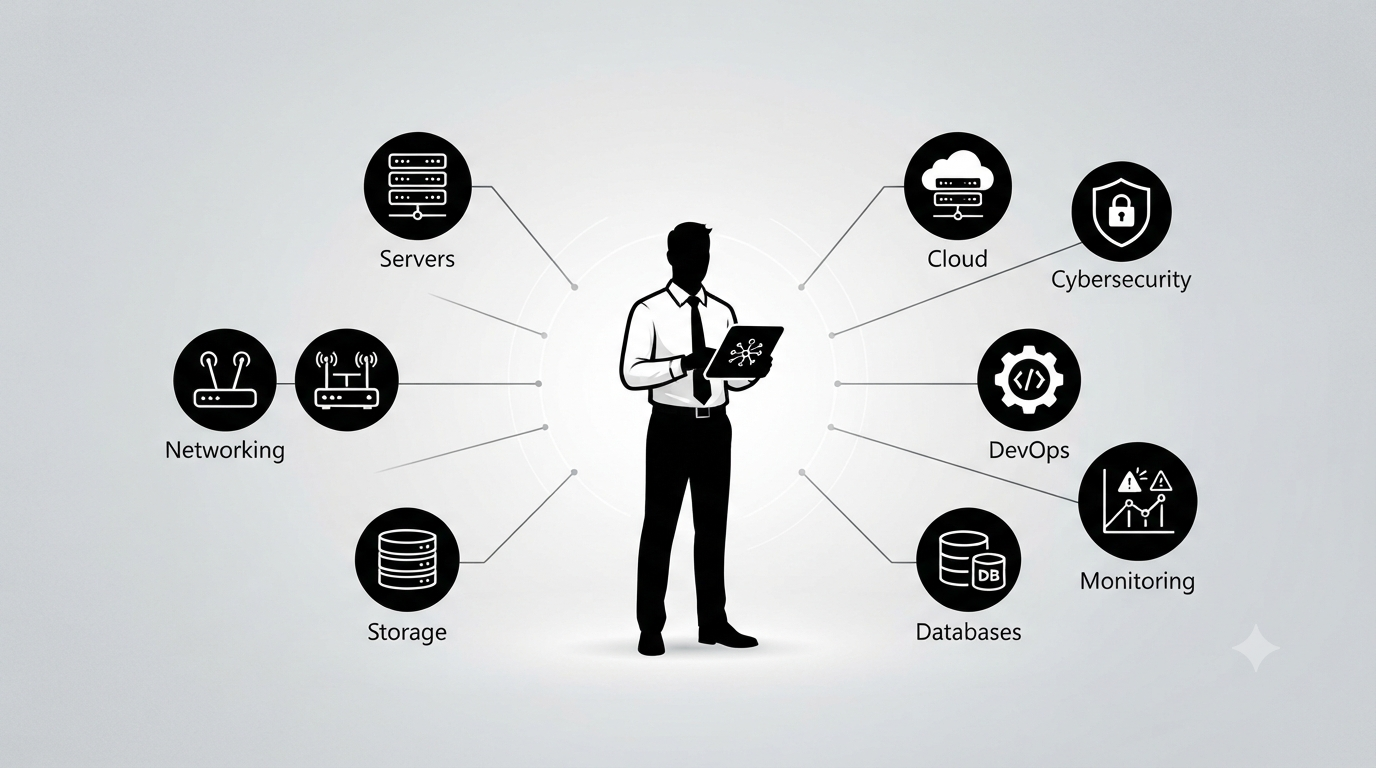
This is where modern infrastructure engineering takes on a broader responsibility. Infrastructure engineers are no longer simply responsible for designing, deploying, and maintaining reliable technology platforms. They must also continuously evaluate whether infrastructure is appropriately sized, provisioned, and utilized. Right-sizing compute resources, selecting appropriate storage tiers, optimizing database capacity, reviewing network consumption, and eliminating underutilized or redundant resources should be part of the ongoing engineering lifecycle. Right-provisioning is equally important: deploying the appropriate resources for actual workload requirements rather than defaulting to excessive capacity for the sake of convenience or perceived performance insurance. Automation, infrastructure-as-code, workload analysis, auto scaling, and scheduled resource management can further help maintain the balance between performance, availability, scalability, and cost efficiency.
Ultimately, infrastructure cost optimization is no longer exclusively a finance function or a cloud governance initiative; it is a fundamental responsibility of modern technology engineering. The objective is not simply to reduce spending, but to ensure that every infrastructure dollar delivers measurable value without compromising reliability, security, or performance. Just as traditional infrastructure teams were expected to maximize the return on hardware investments, today’s engineering teams must continuously maximize the return on cloud consumption. The organizations that succeed will be those that embrace cost awareness as part of their engineering culture, making continuous monitoring, right-sizing, and right-provisioning standard operating practices. In the cloud era, infrastructure efficiency is not achieved at deployment time; it is earned every day through disciplined engineering and continuous optimization.

Founder – mekena.io